Newsletter 06 | January 2026


This author has not written his bio yet.
But we are proud to say that hssmi contributed 18 entries already.
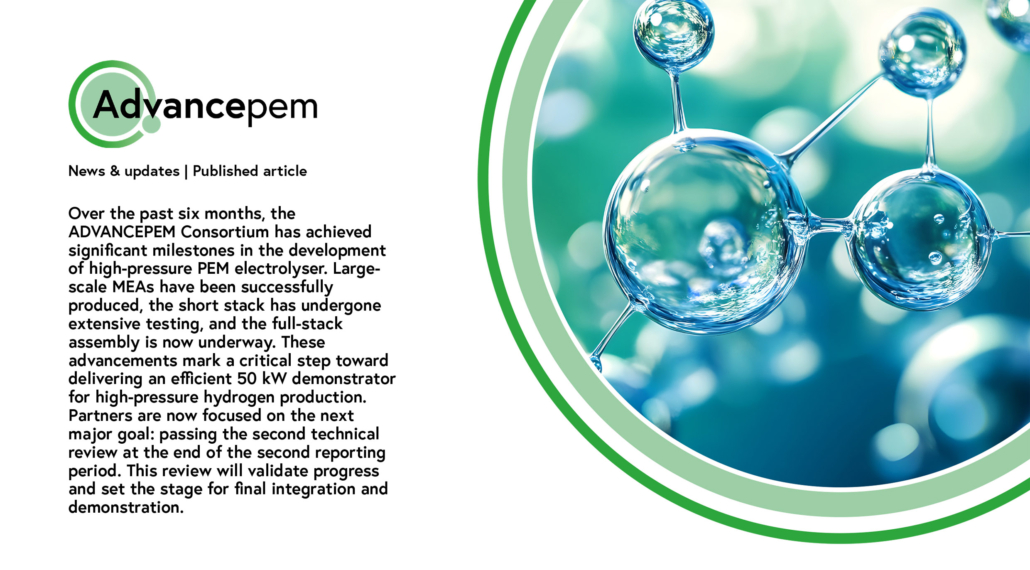
The sixth ADVANCEPEM newsletter has been published summarising the results of the project so far.
Read the full newsletter here.
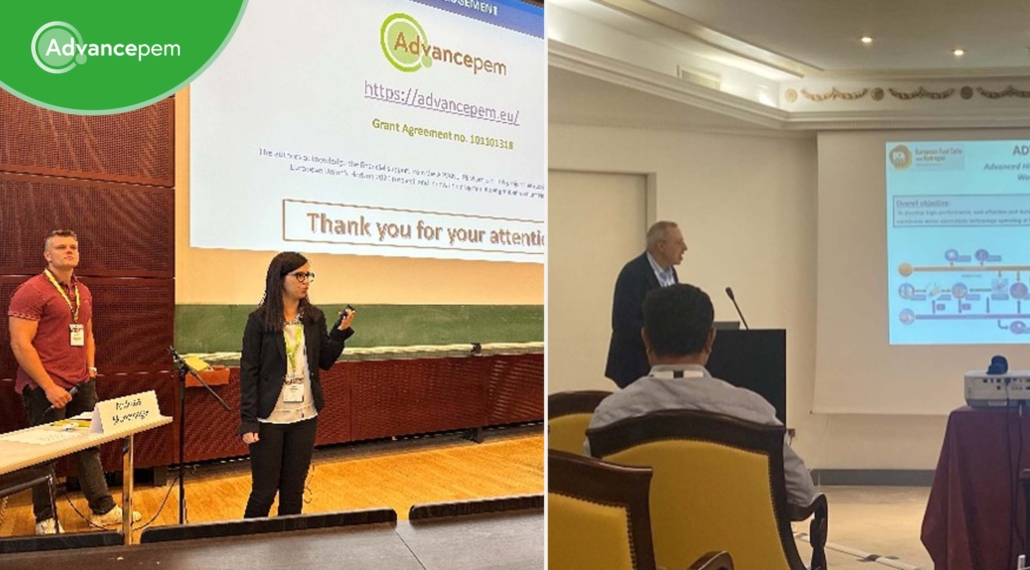
Researchers from CNR-ITAE recently presented new findings on short-side chain Aquivion® membranes at two major European conferences.
Fausta Giacobello, researcher at CNR-ITAE, attended the 5th International Conference on Electrolysis in Freiburg, Germany. Her presentation focused on key results from a detailed assessment of the performance and durability of Aquivion® membranes, aimed at improving PEM electrolysis.
Antonino S. Aricò, Director of CNR-ITAE, shared the latest developments on high-performance, thin short-side chain Aquivion® membranes at the European Fuel Cell and Hydrogen Piero Lunghi Conference in Capri, Italy.
These findings represent a significant step toward more efficient and cost-effective high-pressure PEM water electrolysis, supporting the advancement of green hydrogen production.
Below are the abstracts from both presentations.
Abstract – Aquivion® membranes with low equivalent weight for improved PEM water electrolysis
To achieve sustainable growth and mitigate the effects of climate changes, the transition from fossil fuels to cleaner energy sources is becoming important. The development of new energy vectors and their integration with renewable energy sources and the energy grid infrastructure, however, present challenging barriers. It is often acknowledged that creating more scalable and effective storage solutions is essential to a sustainable future.[1] Green hydrogen, generated via electrolysis, offers significant advantages: high energy density, improved transport efficiency and diverse applications spanning energy conversion and numerous industrial processes. PEM (proton exchange membrane) electrolysis is a particularly advantageous technology for water splitting, achieving high current densities, superior efficiency, high-purity hydrogen production and rapid response. [2-3] This study investigates the performance and durability of different Aquivion® short side chain membranes for PEM electrolysis, a crucial area for developing highly efficient and stable electrolyzers. The research compares bare cast polymers, radical scavenger-containing polymers, and reinforced films, evaluating their performance in MEAs (membrane-electrode assemblies) by means of polarization tests, EIS (electrochemical impedance spectroscopy), and long-term (2000 hour) durability tests. Further analysis using XRD, XRF, TEM, SEM, and optical microscopy clarify membrane and ionomer dispersion characteristics within the MEAs and their impact on overall performance and durability. Using both reinforced and radical scavenger-based membranes, an outstanding electrolysis performance was obtained at 90°C with 1.87 V at 5 A cm-2 . The voltage efficiency at 5 A cm-2 is around 79%. To decrease the final cost of green hydrogen and the amount of renewable energy used, high voltage efficiencies are required. High operational current densities, on the other hand, are basically associated with lower capital costs because of the increased output rate. This is necessary for PEM to minimize utilization of CRMs. Postoperation analyses have shown minimal changes in the catalytic layers and essentially no membrane thinning. All this evidence indicate promising durability perspectives for the modified membranes.
Abstract – High performance of a thin short-side-chain Aquivion® membrane for sustainable water electrolysis application
A perfluorosulfonic acid (PFSA) Aquivion® membrane (C98 05S-RSP) based on Ce-radical scavenger technology was developed and evaluated for use in polymer electrolyte membrane (PEM) electrolyzers. Manufactured by Solvay Specialty Polymers, the membrane had an equivalent weight (EW) of 980 g/eq and a thickness of 50 μm to minimize ohmic losses at high current densities. The electrochemical properties and gas crossover were assessed after creating a membrane-electrode assembly (MEA) over a temperature range of 30 to 90°C and under varying differential pressures (ambient, 10, and 20 bars). For comparison, bare extruded (E98 05S) and reinforced (R98 05S) PFSA Aquivion® membranes with similar EWs and thicknesses were tested under the same conditions to evaluate their performance, stability, and hydrogen crossover. The membrane manufacturing method had a notable impact on the interfacial properties, with the electrodes influencing polarization resistance, H2 permeation in the oxygen stream, and the degradation rate, as indicated by the durability tests.
Antonino S. Aricò, director of CNR-ITAE, presented the latest findings on high-pressure PEM water electrolysis at the European Fuel Cell Forum 2025 in Lucerne, Switzerland.
This high-pressure approach aims to significantly reduce energy use by minimising post-electrolysis compression.
The team at CNR tested several PFSA membranes, including cast, reinforced and radical scavenger-enhanced variants, showing promising electrochemical performance and long-term stability over 2,000 hours. Advanced characterisation techniques such as XRD, XRF, TEM and SEM were used to assess the physical and chemical stability of membrane-electrode assemblies before and after operation.
These results mark an important step toward more efficient, cost-effective PEM water electrolysis for green hydrogen production.
Below is the abstract of the presentation.
Abstract – An innovative PEM water electrolysis system for green hydrogen production
Proton exchange membrane water electrolysis (PEMWE) powered by renewable sources is gaining importance for green hydrogen production. This technology is particularly suitable for operation with intermittent loads facilitating grid balancing service when required by differences in energy generation and consumption. By improving PEM water electrolysis technology, it can be possible to enhance grid services, including improving power quality, controlling frequency and voltage, reducing peak, load shifting, and responding to consumer demand changes. To enable large-scale use of PEMWEs, it’s crucial to lower capital costs. Moreover, innovations that allow higher current density, increased operating temperatures, and greater hydrogen pressure are necessary for significant advancements in technology. The ADVANCEPEM project aims to develop an innovative PEM electrolyser able to generate hydrogen at extremely high pressure (200 bar), which will minimize the energy needed for subsequent compression processes. Producing highly pressurized hydrogen directly from water electrolysis can significantly reduce the energy needed compared to compressing the gas afterward. The study expects to lower capital costs by reducing the amount of critical raw materials used, developing cost-effective coated bipolar plates, and utilizing reinforced PFSA polymer membranes that exhibit high conductivity, glass transition temperatures and crystallinity. Cast, cast with radical scavenger powder and reinforced membranes were electrochemically investigated by means of polarization tests, impedance spectroscopy analysis (EIS), and stability tests over 2000 hours. In addition, X-ray diffraction (XRD), X-ray fluorescence (XRF), transmission electron microscopy (TEM) and scanning electron microscopy (SEM) techniques were employed to investigate the chemical-physical properties and the morphology of the membrane-electrode assemblies (MEAs) under study before and after the steady-state tests.
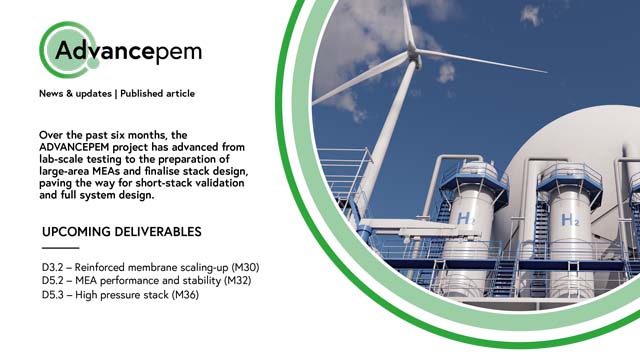
The fifth ADVANCEPEM newsletter has been published summarising the results of the project so far.
Read the full newsletter here.
On April 9th the ADVANCEPEM consortium held its eighth meeting in London, UK. Hosted by HSSMI, the event brought together representatives from all partners to present updates on their respective Work Packages and discuss the project’s progress.
A key point of discussion was the outcome of the mid-term review. The reviewers approved all deliverables submitted during the first half of the project and recognised the technical progress made to date. However, in light of delays affecting certain activities, they recommended extending the project timeline. A 12-month extension, moving the project’s end date to January 2027, has since been approved.
As of this meeting, one new deliverable was submitted on schedule (Month 24), namely Deliverable D4.2 – Report on Catalyst Scaling-Up. Activities within Work Package 4 are now complete, with CNR-ITAE having provided IRD with anode, cathode and recombination catalysts for MEA manufacturing. Additional batches will be supplied if required.
Two deliverables originally due at Month 24 have been postponed following the extension:
Deliverable D1.3 – Annual Data Reporting for Clean Hydrogen JU (Year 2) is planned for submission at the end of April (Month 27).
The next in-person meeting will take place in October 2025 (Month 33) at Oort Energy in Bristol, UK. By that time, short-stack testing is expected to be completed and progress will be reviewed on the finalisation of system design and preparations for full stack assembly.

The fourth ADVANCEPEM newsletter has been published summarising the results of the project so far.
Read the full newsletter here.

Antonino S. Aricò, director of CNR-ITAE, and Benedetta Brancato, researcher fellow at CNR-ITAE, presented their latest findings at HYCELTEC 2024, the IX Symposium on Hydrogen, Fuel Cells and Advanced Batteries. This interdisciplinary forum, scheduled from the 30th of June to the 3rd of July in Milazzo (Italy), brought together experts and researchers from academia, technological centres and industry to discuss advancements in the field of energy technologies.
The first presentation, held by Dr. Aricò, focused on green hydrogen production by innovative membrane electrolysis technologies, while Benedetta Brancato gave a presentation on the development of a scalable manufacturing process to produce MEAs with high accessible electrochemical surface area for PEM electrolysis.

The third ADVANCEPEM newsletter has been published summarising the results of the project so far.
Read the full newsletter here.

This past April over 500 exhibitors from the hydrogen and fuel cell sector attended the world-famous Hannover Messe. For the second year in a row, Oort Energy was one of the companies taking part.
Three delegates travelled from the Oort Energy Bristol offices to Hannover, Germany, alongside their 400 lb mock stack. For an entire week Marcus Bull – Chief Operating Officer, James Dodwell – co-founder and Technical Director and Emma Ingledew – Marketing Executive, successfully manned a stand in the Hydrogen and Fuel Cells Hall. The company received a great deal of attention, partly due to their impressive mock stack and to their ability to prove that within two years they had systems out in the field being delivered.
The highlight of the trip was an interesting discussion with delegates from NASA regarding fuel cells. Despite being a long and tiring week, the Hannover Messe was highly successful for Oort Energy. Here’s looking forward to next year!

Stefania Siracusano, senior researcher at CNR-ITAE, presented the latest publication on membrane-electrode assembly development during the 14th International Conference on Hydrogen Technologies which took place in Prague (Czech Republic) between March 20th – 24th 2024. The findings of the study, carried out in collaboration with scientists at Syensqo, significantly contribute to the ADVANCEPEM project objectives on catalysts, membrane and MEA development for operation at high current density.
Abstract
A membrane-electrode assembly based on the chemically stabilised short-side-chain proton exchange Aquivion® membrane containing a Cerium (Ce)-radical scavenger was investigated for operation at a high current density with a reduced concentration of H2 in O2 and with improved stability in a water electrolysis (WE) cell. However, at the beginning of life, the performances were low due to the exchange of protons with Ce ions from the radical scavenger, and it was observed that the performance improved with time, making this system more efficient than an extruded and reinforced membranes with similar equivalent weight (EW) of 980 g/eq and a thickness of 50 μm. Moreover, a lower H2 concentration in O2 was observed for the Ce-based membrane compared to the bare membrane-based MEAs.
The present study demonstrates that membrane manufacturing and the presence of a Ce nanofiller significantly influence the properties at the interface with the electrodes in a PEM WE cell. In particular, the Ce-based radical scavenger-based perfluorosulfonic acid Aquivion® membrane provided excellent resilience to degradation and a lower H2 content in the O2 stream. An increase in performance during a 3,500 h durability test indicated that the nanofiller was effective in improving the system’s stability.


© 2023 ADVANCEPEM


This site uses cookies. By continuing to browse the site, you are agreeing to our use of cookies.
Accept settingsHide notification onlySettingsWe may request cookies to be set on your device. We use cookies to let us know when you visit our websites, how you interact with us, to enrich your user experience, and to customize your relationship with our website.
Click on the different category headings to find out more. You can also change some of your preferences. Note that blocking some types of cookies may impact your experience on our websites and the services we are able to offer.
These cookies are strictly necessary to provide you with services available through our website and to use some of its features.
Because these cookies are strictly necessary to deliver the website, refusing them will have impact how our site functions. You always can block or delete cookies by changing your browser settings and force blocking all cookies on this website. But this will always prompt you to accept/refuse cookies when revisiting our site.
We fully respect if you want to refuse cookies but to avoid asking you again and again kindly allow us to store a cookie for that. You are free to opt out any time or opt in for other cookies to get a better experience. If you refuse cookies we will remove all set cookies in our domain.
We provide you with a list of stored cookies on your computer in our domain so you can check what we stored. Due to security reasons we are not able to show or modify cookies from other domains. You can check these in your browser security settings.
These cookies collect information that is used either in aggregate form to help us understand how our website is being used or how effective our marketing campaigns are, or to help us customize our website and application for you in order to enhance your experience.
If you do not want that we track your visit to our site you can disable tracking in your browser here:
We also use different external services like Google Webfonts, Google Maps, and external Video providers. Since these providers may collect personal data like your IP address we allow you to block them here. Please be aware that this might heavily reduce the functionality and appearance of our site. Changes will take effect once you reload the page.
Google Webfont Settings:
Google Map Settings:
Google reCaptcha Settings:
Vimeo and Youtube video embeds:
The following cookies are also needed - You can choose if you want to allow them:
You can read about our cookies and privacy settings in detail on our Privacy Policy Page.
Privacy Policy