Entries by hssmi

FDFC 2026 – CNR-ITAE
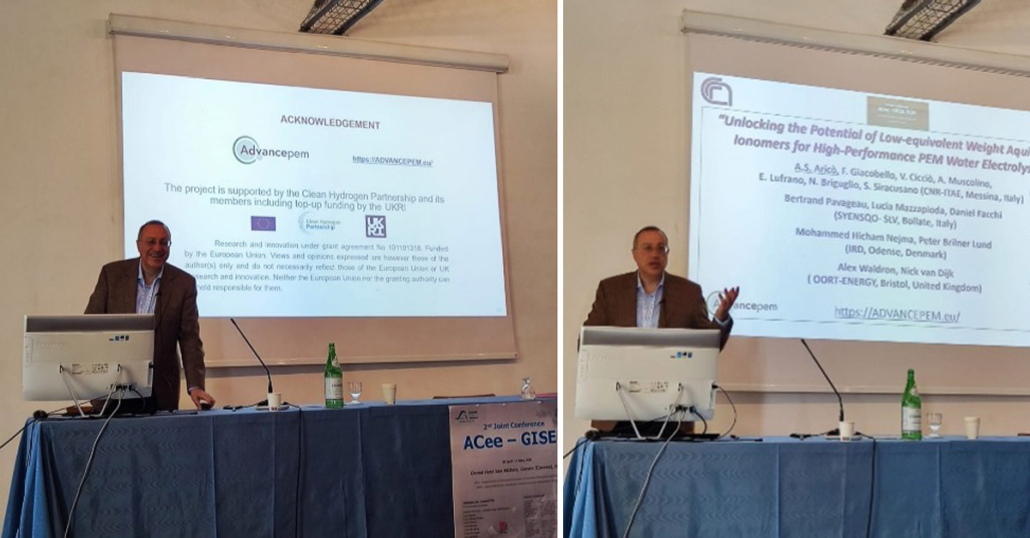
Figure 1 - Dr Antonino S. Aricò presenting at the 10th International Conference on Fundamentals & Developments of Fuel Cells and Electrolysers (FDFC2026) in Montpellier, France.

Antonino S. Aricò, Director of CNR-ITAE, recently attended the 10th International Conference on Fundamentals & Developments of Fuel Cells and Electrolysers (FDFC2026) in Montpellier, France.  

The presentation illustrated the latest results on the application of chemically stabilised short-side-chain proton exchange Aquivion® membrane containing a Ce-radical scavenger for high-current density and high-pressure water electrolysis. 


Below is the abstract from the presentation. 


Abstract – Pressurised PEM water electrolyser based on a thin short-side-chain Aquivion® membrane 

Chemically stabilised short-side-chain proton exchange Aquivion® membrane containing a Ce-radical 

scavenger was investigated for operation at a high current density with a reduced concentration of H2 in O2 and with improved stability in a water electrolysis single cell. At the beginning of life, the performance was initially low due to proton exchange with Ce ions released by the scavenger; however, performance increased by time, resulting in a system more efficient than of bare extruded and reinforced membranes. In addition, the Ce-scavenger-based membrane exhibited a lower H₂ concentration in O₂ compared with MEAs using unmodified membranes, indicating that an increased tortuosity effect for the gas crossover induced by the Ce-based nanofiller. This study demonstrates that membrane fabrication and the presence of a Ce nanofiller strongly affect the interfacial properties between membrane and electrodes in PEM water electrolysis. Specifically, the Ce-containing Aquivion® perfluorosulfonic acid membrane showed excellent resistance to degradation and reduced hydrogen content in the oxygen stream. The continued performance improvement observed during a 3,500-hour durability test confirms that the nanofiller effectively enhances system stability. 
Journal publication – CNR-ITAE & Solvay

Figure 1 - International Journal of Hydrogen Energy

In March 2026, researchers from CNR-ITAE and Syensqo published an article on the behaviour of low equivalent weight Aquivion® ionomers for enhanced proton exchange membrane water electrolysis, building on their findings and contribution from the ADVANCEPEM project.  

Below is the abstract, you can find the full article at the following link: Understanding the behaviour of low equivalent weight Aquivion® ionomers for enhanced proton exchange membrane water electrolysis


Abstract

Given the importance of developing highly efficient and stable membranes for PEM electrolysis, this study aims to compare different Aquivion® short side chains membranes in terms of performance and durability. The membranes examined include bare cast polymers, cast polymers containing a radical scavenger and reinforced polymeric films. These membranes were used to prepare membrane-electrode assemblies (MEAs) for hydrogen production that were subjected to polarization tests, electrochemical impedance spectroscopy, and durability tests over 2000 h. In addition, diagnostic techniques such as X-ray diffraction (XRD), X-ray fluorescence (XRF), transmission electron microscopy (TEM), scanning electron microscopy (SEM), and optical microscopic imaging were performed to understand membranes and ionomer dispersion characteristics in MEAs and their role on performance and durability. By analysing the efficiency and stability of Aquivion® systems in different configurations, this study seeks to determine the most appropriate strategies for improving polymer electrolytes used in PEM water electrolysis for green hydrogen production.

Newsletter 06 | January 2026

Figure 1 - The sixth ADVANCEPEM newsletter

The sixth ADVANCEPEM newsletter has been published summarising the results of the project so far.

Read the full newsletter here.

ICE25 & EFCH225 – CNR-ITAE

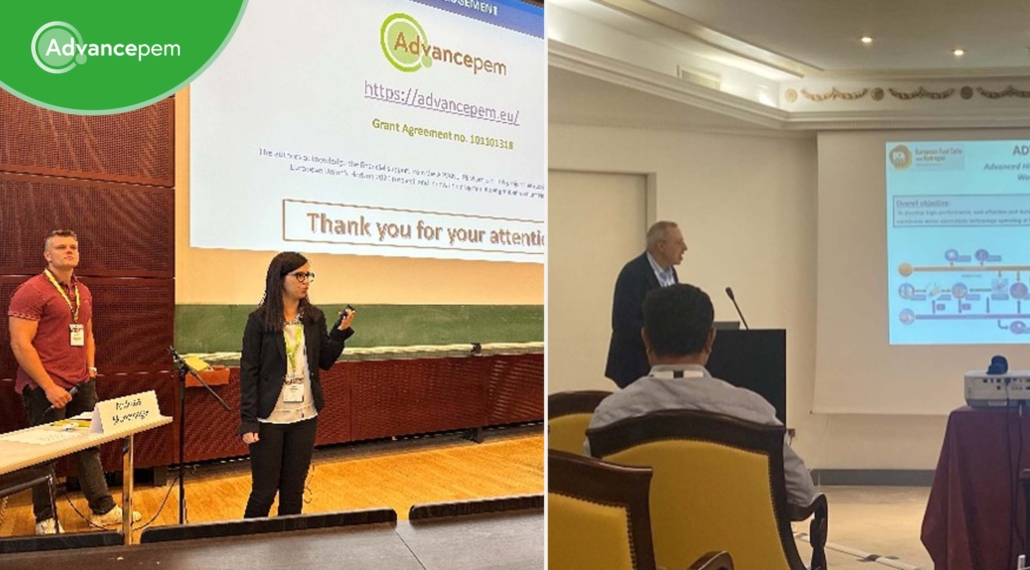
Left: Fausta Giacobello presenting at the 5th International Conference on Electrolysis in Freiburg (Germany). Right: Antonino S. Aricò presenting at the European Fuel Cell and Hydrogen Piero Lunghi Conference in Capri (Italy).

Researchers from CNR-ITAE recently presented new findings on short-side chain Aquivion® membranes at two major European conferences.

Fausta Giacobello, researcher at CNR-ITAE, attended the 5th International Conference on Electrolysis in Freiburg, Germany. Her presentation focused on key results from a detailed assessment of the performance and durability of Aquivion® membranes, aimed at improving PEM electrolysis.

Antonino S. Aricò, Director of CNR-ITAE, shared the latest developments on high-performance, thin short-side chain Aquivion® membranes at the European Fuel Cell and Hydrogen Piero Lunghi Conference in Capri, Italy.

These findings represent a significant step toward more efficient and cost-effective high-pressure PEM water electrolysis, supporting the advancement of green hydrogen production. 

Below are the abstracts from both presentations.

Abstract – Aquivion® membranes with low equivalent weight for improved PEM water electrolysis

To achieve sustainable growth and mitigate the effects of climate changes, the transition from fossil fuels to cleaner energy sources is becoming important. The development of new energy vectors and their integration with renewable energy sources and the energy grid infrastructure, however, present challenging barriers. It is often acknowledged that creating more scalable and effective storage solutions is essential to a sustainable future.[1] Green hydrogen, generated via electrolysis, offers significant advantages: high energy density, improved transport efficiency and diverse applications spanning energy conversion and numerous industrial processes. PEM (proton exchange membrane) electrolysis is a particularly advantageous technology for water splitting, achieving high current densities, superior efficiency, high-purity hydrogen production and rapid response. [2-3] This study investigates the performance and durability of different Aquivion® short side chain membranes for PEM electrolysis, a crucial area for developing highly efficient and stable electrolyzers. The research compares bare cast polymers, radical scavenger-containing polymers, and reinforced films, evaluating their performance in MEAs (membrane-electrode assemblies) by means of polarization tests, EIS (electrochemical impedance spectroscopy), and long-term (2000 hour) durability tests. Further analysis using XRD, XRF, TEM, SEM, and optical microscopy clarify membrane and ionomer dispersion characteristics within the MEAs and their impact on overall performance and durability. Using both reinforced and radical scavenger-based membranes, an outstanding electrolysis performance was obtained at 90°C with 1.87 V at 5 A cm-2 . The voltage efficiency at 5 A cm-2 is around 79%. To decrease the final cost of green hydrogen and the amount of renewable energy used, high voltage efficiencies are required. High operational current densities, on the other hand, are basically associated with lower capital costs because of the increased output rate. This is necessary for PEM to minimize utilization of CRMs. Postoperation analyses have shown minimal changes in the catalytic layers and essentially no membrane thinning. All this evidence indicate promising durability perspectives for the modified membranes.

Abstract – High performance of a thin short-side-chain Aquivion® membrane for sustainable water electrolysis application

A perfluorosulfonic acid (PFSA) Aquivion® membrane (C98 05S-RSP) based on Ce-radical scavenger technology was developed and evaluated for use in polymer electrolyte membrane (PEM) electrolyzers. Manufactured by Solvay Specialty Polymers, the membrane had an equivalent weight (EW) of 980 g/eq and a thickness of 50 μm to minimize ohmic losses at high current densities. The electrochemical properties and gas crossover were assessed after creating a membrane-electrode assembly (MEA) over a temperature range of 30 to 90°C and under varying differential pressures (ambient, 10, and 20 bars). For comparison, bare extruded (E98 05S) and reinforced (R98 05S) PFSA Aquivion® membranes with similar EWs and thicknesses were tested under the same conditions to evaluate their performance, stability, and hydrogen crossover. The membrane manufacturing method had a notable impact on the interfacial properties, with the electrodes influencing polarization resistance, H2 permeation in the oxygen stream, and the degradation rate, as indicated by the durability tests.

EFCF 2025 – CNR-ITAE

Antonino S. Aricò, director of CNR-ITAE, presented the latest findings on high-pressure PEM water electrolysis at the European Fuel Cell Forum 2025 in Lucerne, Switzerland. 

This high-pressure approach aims to significantly reduce energy use by minimising post-electrolysis compression.  

The team at CNR tested several PFSA membranes, including cast, reinforced and radical scavenger-enhanced variants, showing promising electrochemical performance and long-term stability over 2,000 hours. Advanced characterisation techniques such as XRD, XRF, TEM and SEM were used to assess the physical and chemical stability of membrane-electrode assemblies before and after operation. 

These results mark an important step toward more efficient, cost-effective PEM water electrolysis for green hydrogen production. 

Below is the abstract of the presentation. 

Abstract – An innovative PEM water electrolysis system for green hydrogen production 

Proton exchange membrane water electrolysis (PEMWE) powered by renewable sources is gaining importance for green hydrogen production. This technology is particularly suitable for operation with intermittent loads facilitating grid balancing service when required by differences in energy generation and consumption. By improving PEM water electrolysis technology, it can be possible to enhance grid services, including improving power quality, controlling frequency and voltage, reducing peak, load shifting, and responding to consumer demand changes. To enable large-scale use of PEMWEs, it’s crucial to lower capital costs. Moreover, innovations that allow higher current density, increased operating temperatures, and greater hydrogen pressure are necessary for significant advancements in technology. The ADVANCEPEM project aims to develop an innovative PEM electrolyser able to generate hydrogen at extremely high pressure (200 bar), which will minimize the energy needed for subsequent compression processes. Producing highly pressurized hydrogen directly from water electrolysis can significantly reduce the energy needed compared to compressing the gas afterward. The study expects to lower capital costs by reducing the amount of critical raw materials used, developing cost-effective coated bipolar plates, and utilizing reinforced PFSA polymer membranes that exhibit high conductivity, glass transition temperatures and crystallinity. Cast, cast with radical scavenger powder and reinforced membranes were electrochemically investigated by means of polarization tests, impedance spectroscopy analysis (EIS), and stability tests over 2000 hours. In addition, X-ray diffraction (XRD), X-ray fluorescence (XRF), transmission electron microscopy (TEM) and scanning electron microscopy (SEM) techniques were employed to investigate the chemical-physical properties and the morphology of the membrane-electrode assemblies (MEAs) under study before and after the steady-state tests.  

Newsletter 05 | July 2025

The fifth ADVANCEPEM newsletter has been published summarising the results of the project so far.

Read the full newsletter here.

Figure 1 - The fifth ADVANCEPEM newsletter

ADVANCEPEM 27M Consortium Meeting 

On April 9th the ADVANCEPEM consortium held its eighth meeting in London, UK. Hosted by HSSMI, the event brought together representatives from all partners to present updates on their respective Work Packages and discuss the project’s progress. 

A key point of discussion was the outcome of the mid-term review. The reviewers approved all deliverables submitted during the first half of the project and recognised the technical progress made to date. However, in light of delays affecting certain activities, they recommended extending the project timeline. A 12-month extension, moving the project’s end date to January 2027, has since been approved. 

As of this meeting, one new deliverable was submitted on schedule (Month 24), namely Deliverable D4.2 – Report on Catalyst Scaling-Up. Activities within Work Package 4 are now complete, with CNR-ITAE having provided IRD with anode, cathode and recombination catalysts for MEA manufacturing. Additional batches will be supplied if required. 

Two deliverables originally due at Month 24 have been postponed following the extension: 

  • D3.2: Reinforced Membrane Scaling-Up, now expected by Month 30. 
  • D5.2: MEA Performance and Stability, now scheduled for submission in Month 32. 

Deliverable D1.3 – Annual Data Reporting for Clean Hydrogen JU (Year 2) is planned for submission at the end of April (Month 27). 

The next in-person meeting will take place in October 2025 (Month 33) at Oort Energy in Bristol, UK. By that time, short-stack testing is expected to be completed and progress will be reviewed on the finalisation of system design and preparations for full stack assembly. 

Figure 1 – Consortium Partners at the social dinner after the 27M meeting (London, 09/04/2025)

Newsletter 04 | February 2025

The fourth ADVANCEPEM newsletter has been published summarising the results of the project so far.

Read the full newsletter here.

Figure 1 - The fourth ADVANCEPEM newsletter

Hyceltec 2024 – CNR-ITAE

Antonino S. Aricò, director of CNR-ITAE, and Benedetta Brancato, researcher fellow at CNR-ITAE, presented their latest findings at HYCELTEC 2024, the IX Symposium on Hydrogen, Fuel Cells and Advanced Batteries. This interdisciplinary forum, scheduled from the 30th of June to the 3rd of July in Milazzo (Italy), brought together experts and researchers from academia, technological centres and industry to discuss advancements in the field of energy technologies. 

The first presentation, held by Dr. Aricò, focused on green hydrogen production by innovative membrane electrolysis technologies, while Benedetta Brancato gave a presentation on the development of a scalable manufacturing process to produce MEAs with high accessible electrochemical surface area for PEM electrolysis. 

Figure 1 - HYCELTEC 2024

Newsletter 03 | August 2024

The third ADVANCEPEM newsletter has been published summarising the results of the project so far.

Read the full newsletter here.

Figure 1 - The third ADVANCEPEM newsletter